Best Language Learning Apps (2026)
Updated June 2026 · Independent reviews, ranked by what each app does best
Search for the best language learning app and you'll get a hundred "top 10" lists that all rank the same apps in a different order. The truth is less tidy: the best language learning app is the one that matches your goal, your budget and your learning style. An app built to get you speaking looks nothing like one built to drill vocabulary or teach grammar — and ranking them on a single line is how those other lists go wrong.
So instead of one master list, this guide ranks the best language learning apps of 2026 by what each is actually good at. We've focused on the apps that come up again and again — Duolingo, Babbel, Pimsleur, Busuu, Memrise and Rosetta Stone — and matched each to the learner it suits, with honest notes on price, free options and where it falls short.

The best language learning apps at a glance
Here's the short version before the detail. Every app below is a strong pick for the right learner; the "best for" column is where each one genuinely leads.
| App | Best for | Price | Free option | Rating |
|---|---|---|---|---|
| Pimsleur | Speaking & listening | $19.95/mo | 7-day trial | 4.1/5 |
| Babbel | Grammar & structure | $15.25/mo | First lesson | 4.2/5 |
| Duolingo | Free, gamified habit | Free / ~$7/mo | Yes, forever | 4.0/5 |
| Busuu | Native-speaker feedback | ~$13.95/mo | Limited tier | 4.0/5 |
| Memrise | Vocabulary via real video | ~$8.49/mo | Limited tier | 3.9/5 |
| Rosetta Stone | Immersion, no translation | $19.99/mo | 3-day trial | 3.8/5 |
Now the detail — and why each app earns its spot.
How we picked the best language learning apps
A language learning app has to do more than look slick on the app store. We judged each one on the things that actually move a beginner toward speaking a new language:
- Speaking & pronunciation — does it get you talking, not just tapping?
- Vocabulary & grammar — how well it builds words, phrases and the rules behind them.
- Learning method — audio, gamified, immersion or grammar-led, and who each suits.
- Languages offered — from a single language to dozens.
- Price & free options — the free version or free trial, and value per hour.
- Learning experience — how it feels to use day after day.
We also weighed the learning method itself, because the best method for one learner is the wrong one for another. We tested these various language learning apps the way a real language learner would: setting clear learning goals, judging each language course on its best features and the language skills it builds, and watching how the language learning experience holds up over weeks of studying a language. Different apps optimise for different goals, so we ranked by fit, not hype.

1. Pimsleur — best for speaking and listening
If your goal is to speak and understand a language fast, Pimsleur is the best language learning app on this list. Built on Dr. Paul Pimsleur's graduated interval recall, it's audio-first: every 30-minute lesson has you responding out loud, so pronunciation and the reflex of answering without translating in your head develop early. It's the app most likely to get a true beginner holding a basic conversation with a native speaker within weeks.
The trade-offs are real — it's light on reading, writing and explicit grammar, and the vocabulary range is narrower than a full course. But for the one job of getting words and phrases out of your mouth, nothing here beats it. Read our full Pimsleur review, the language-specific Pimsleur Spanish review and Pimsleur Korean review, or compare it with a broader Spanish course in Rocket Spanish vs Pimsleur.
Best for: speaking and listening, hands-free learning · Price: $19.95/mo, 7-day free trial · Languages: 50+
Try Pimsleur free for 7 days →
2. Babbel — best for grammar and structure
Babbel is the best language learning app if you learn best by seeing the rules. Its short, screen-based lessons explain grammar explicitly and drill reading, writing and conversation in a structured path, which many learners find more satisfying than pure repetition. On a European language it's also cheaper than Pimsleur, especially on an annual plan, and it tends to take you further per hour for understanding the language.
The limits: Babbel covers 14 mostly European languages — no Korean, Japanese or Arabic — and it's lighter on the speak-out-loud practice that Pimsleur specialises in. For a head-to-head, see our Pimsleur vs Babbel comparison.
Best for: grammar, structure, reading & writing · Price: $15.25/mo (annual $8.97/mo) · Languages: 14
Try Babbel's first lesson free →
3. Duolingo — best free, gamified app
Duolingo is the best free language learning app, full stop. The core app is genuinely free, it covers 40+ languages, and its gamified streaks and points make learning feel like a game and showing up daily effortless — which is half the battle in language studies. For building broad vocabulary, reading recognition and a habit, it's hard to beat, and the optional Super tier removes ads for roughly $7/mo.
Where it's weak is real speaking: you tap and type far more than you talk, so many learners find their conversation lags behind their streak. It's a brilliant on-ramp and a poor finish line. Our Pimsleur vs Duolingo comparison digs into the free-vs-paid trade-off in detail.
Best for: a free, low-pressure daily habit · Price: Free; Super ~$6.99–12.99/mo · Languages: 40+
4. Busuu — best for feedback from native speakers
Busuu's standout feature is its community: you complete short, well-structured lessons, then submit written and spoken exercises that native speakers correct for you. That feedback loop is something most language learning apps simply don't offer, and it makes Busuu a strong choice for the learner who wants to be corrected rather than just drilled. Lessons are mapped to the Common European Framework of Reference (CEFR), so your progress is easy to track against real levels.
It sits between Duolingo and Babbel in feel — more structured than the former, more social than the latter — with a limited free version and around a dozen languages. If accountability and correction matter to you, Busuu earns its place.
Best for: corrections from native speakers · Price: ~$13.95/mo · Languages: 14
5. Memrise — best for vocabulary
Memrise leans hard into one thing and does it well: building vocabulary. It uses spaced-repetition flash cards plus clips of real native speakers saying words and phrases in context, so you learn how the language actually sounds in the wild rather than in a studio. For drilling new vocabulary and listening to everyday speech, it's one of the best apps going, and it's cheaper than most rivals.
As a complete course it's thinner — lighter on grammar and structured progression — so it works best as a vocabulary booster alongside a speaking or grammar app rather than your only tool.
Best for: vocabulary & real native-speaker audio · Price: ~$8.49/mo · Languages: 20+
6. Rosetta Stone — best for immersion
The original big name in language learning software, Rosetta Stone teaches through full immersion: images paired with the target language and no translation, so you absorb meaning the way a child does. It's strong on vocabulary recognition and pronunciation drills via speech recognition, and the all-in immersion approach appeals to learners who dislike grammar tables. Read our full Rosetta Stone review for the verdict.
Critics — and our own read of where it lands among language learning apps — put it mid-pack on actually getting you to produce the language in conversation. It's a solid, polished option, just no longer the automatic top pick it once was.
Best for: immersion, no-translation learning · Price: $19.99/mo · Languages: 25
Best language learning app by goal
Strip away the rankings and the choice gets simple once you know your goal.
| Your goal | Best app | Why |
|---|---|---|
| Speak fast | Pimsleur | Audio-first, speak out loud from lesson one |
| Learn for free | Duolingo | Best free app; add Language Transfer for audio |
| Master grammar | Babbel | Explicit rules and structured conversation |
| Build vocabulary | Memrise | Flash cards and real native-speaker video |
| Get corrected | Busuu | Feedback from native speakers, CEFR-mapped |
| Learn by immersion | Rosetta Stone | Images, no translation |
The best language learning app isn't the one with the most features — it's the one you'll actually open every day, doing the kind of practice your goal needs.
Best app by language: Spanish, French and beyond
The right app also shifts with the language you choose. For a popular language like Spanish, almost every app on this list works — so pick by method: Pimsleur to speak, Babbel for grammar, Duolingo to start free. If you want to learn Spanish specifically, our Pimsleur Spanish review breaks down the deepest audio course on the easiest major language for English speakers. Not sure where you stand? Take our free Spanish level test, or estimate your timeline with our how long to learn Spanish calculator. Learning French instead? Read our Pimsleur French review, take our French level test or estimate your timeline with the how long to learn French calculator. For app-by-app picks in one language, see our best apps to learn French and best apps to learn Japanese guides.
For a harder, less common target language — Korean, Japanese, Arabic — your options narrow fast, because Babbel and many others don't offer them. There, an app with a big catalogue like Pimsleur or Duolingo (or a dedicated app) is the realistic choice; see our Pimsleur Korean review for how the audio method handles a Category IV language. Whether you want to learn French with structured French lessons, pick up Spanish, or tackle Korean as a tougher second language — even English as a second language — match the app to both the language and the skill you care about most. If you only need a single language, a one-language plan is cheaper; if you're completely new to the language, start with a gentle on-ramp.

Best apps by language
Want the picks for one specific language? Jump straight to the dedicated guides:

Best app to learn French
See the picks →
Best app to learn Japanese
See the picks →Pimsleur pricing & deals
Looking at Pimsleur specifically? These guides cover the cost, the free trial and how to save:
Pimsleur free trial
See the trial →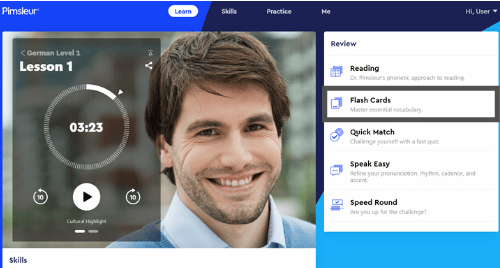
Pimsleur discount & codes
Find a deal →
How much does Pimsleur cost?
See pricing →What Reddit actually recommends
Skip the marketing and read r/languagelearning for an evening and a very consistent picture emerges — one that matches our testing more than most "top 10" lists do. The Reddit consensus, honestly summarised: no app makes you fluent and anyone claiming otherwise gets downvoted; Duolingo is respected as a habit and doubted as a course — the running joke is a two-year streak and no conversations to show for it; Pimsleur and audio-first methods earn the most credit for actual speaking, with the recurring caveat that they're light on reading; Anki (free spaced-repetition flashcards) is the community's vocabulary workhorse; and the most-upvoted advice in almost every thread is to talk to real humans early — a tutor on italki or an exchange partner beats any app feature. If you weight real users' experience heavily, that consensus is worth more than any ranking, including ours.
The best language learning apps that aren't Duolingo
A surprising number of people search for exactly this — usually after a long streak that didn't turn into conversations. If you're leaving the owl, pick your exit by what was missing: if it's speaking, go to Pimsleur (audio-first, talking from lesson one); if it's understanding the grammar, go to Babbel; if it's vocabulary that sticks, Memrise or free Anki decks; if you want a human to correct you, Busuu or an italki tutor. All of them fix a specific Duolingo weakness — which one depends on why you're leaving.
The best language learning apps without AI
As AI voices and chatbot tutors spread through language apps, a growing group of learners wants the opposite: real human voices and human-made lessons. Fair enough — pronunciation is exactly where you don't want a synthetic model. The strongest AI-free picks: Pimsleur, whose entire method is built on studio recordings of native speakers and decades of human-designed curriculum; Language Transfer, one teacher's genuinely free audio course; and Memrise, whose best feature is real video of native speakers in the street. All three predate the AI wave and are better for it.
Can you really learn a language for free?
Partly, yes. You can absolutely learn a language to a useful conversational level without paying, especially with Duolingo's free tier plus free audio like Language Transfer and free native content — podcasts, shows, YouTube. Free apps work by gamifying short daily lessons and leaning on spaced repetition to grow your vocabulary over time, and for a casual learner that's often enough to start.
The strongest free options right now:
- Duolingo — full free tier, 40+ languages, gamified daily practice.
- Language Transfer — a free audio course focused on speaking and reasoning.
- Memrise & Busuu — limited free tiers worth trying before you pay.
- Free trials — Pimsleur (7 days) and Rosetta Stone (3 days) let you test paid apps free.
The catch is depth and speaking. Free apps are lightest exactly where progress is hardest — sustained speaking practice and structured grammar — which is why so many serious learners eventually add one paid app (often Pimsleur for speaking or Babbel for structure) on top of a free base. The cheapest strong setup is a free habit plus one paid specialist.
How long does it take to become fluent?
Longer than any app's marketing implies, and it depends heavily on the language. Using the Common European Framework of Reference for Languages (CEFR) as a yardstick, the best language learning apps reliably carry a motivated beginner to a confident A2–B1 — comfortable, conversational, able to handle daily life with a native speaker. True fluency (C1+) needs hundreds more hours of real conversation and native content than any app delivers alone.
That's not a knock on the apps; it's what they're for. Used well, an app is the fastest, cheapest way to get from zero to conversational, after which real practice takes over. Pair the right app with regular speaking and you'll move toward fluent far faster than starting from scratch with a textbook.
Getting the most out of any language app
Whichever you pick, a few habits separate the learners who succeed from those who quit — and the biggest predictor isn't the app, it's your commitment to learning a little every day. Treat your daily language lessons as non-negotiable, the way a serious language learner does, and even a free app compounds fast. Every good app offers a streak or reminder for exactly this reason.
A second best practice: don't rely on one tool for everything. Most apps are strong at one or two language skills and weak elsewhere, so the strongest setups combine two or three apps — one for speaking the language and another app for learning new words and phrases. When you start learning to speak, front-load listening and speaking; reading and grammar are easier to add later in your learning journey.
Finally, get spoken language practice with real people as early as you can. No app fully replaces conversation, so once you can string sentences together, add language tutors or a conversation partner. The apps with dozens of language options make it tempting to learn languages in parallel, but most people progress faster focusing on a single language at a time. Daily language practice, a couple of complementary apps, and real conversation — that combination is how the best language learning apps actually deliver.
Start your free 7-day Pimsleur trial →
Frequently asked questions
What is the best language learning app?
There is no single best language learning app for everyone — it depends on your goal. For speaking, Pimsleur leads; for grammar and structure, Babbel; for a free, gamified habit, Duolingo; for vocabulary, Memrise; and for immersion, Rosetta Stone.
What is the best free language learning app?
Duolingo is the best free language learning app for most people: a genuinely free tier, gamified lessons and 40+ languages. Language Transfer is a strong free audio option, and Memrise and Busuu have limited free versions.
Is Duolingo or Babbel better?
Babbel teaches more grammar and structured conversation and tends to take you further per hour; Duolingo is free, more gamified and better for building a daily habit. Many learners start free on Duolingo and switch to Babbel when they want depth.
What is the best app for speaking a language?
Pimsleur. Its audio-first method has you speaking out loud and building pronunciation from the first lesson, which is the skill most apps neglect. Busuu and Babbel add speaking practice; Duolingo is the weakest of the group on real speaking.
Memrise vs Duolingo — which is better?
Memrise focuses on vocabulary with native-speaker videos, while Duolingo is a broader gamified course. For pure vocabulary retention Memrise is excellent; for an all-round free habit, Duolingo wins.
Can you become fluent with a language app?
No app alone makes you fluent — that needs real conversation and native content. But the best language learning apps take you to a confident conversational level (roughly CEFR B1) far faster than going it alone, especially when you pair an app with speaking practice.
What do Reddit users say is the best language learning app?
The consistent consensus on r/languagelearning: no app alone gets you fluent, Duolingo is fine as a habit but overrated as a course, Pimsleur and audio methods get the most credit for actual speaking, Anki for vocabulary, and the highest-rated 'tool' is real conversation — a tutor or exchange partner — as early as possible.
Are there good language learning apps without AI?
Yes. Pimsleur's lessons are built on recordings of real native speakers (the method predates AI by decades), Language Transfer is entirely human-taught audio, and Memrise's signature feature is video of real native speakers. If you want to avoid AI-generated voices and chatbot tutors, those three are the strongest picks.
The verdict: which language learning app should you use?
Choose by goal, not by rank. For pure speaking, Pimsleur is the best language learning app here; for grammar and structure, Babbel; for a free, gamified habit, Duolingo; for vocabulary, Memrise; for native-speaker feedback, Busuu; and for immersion, Rosetta Stone. Most successful learners don't pick just one — they pair a free habit-builder with a paid specialist that targets the skill they care about. Start with the free trial of whichever matches your goal, learn for a week, and let your own experience pick the winner.